Kitchen
Gloves are not a sink
Kitchen5 min read
Your hands look clean. You have emptied the bin, checked your phone, smoked a cigarette behind the container, and you pull on a pair of gloves for the salad. That is not hygiene. That is a glove over something you have not washed.
In a restaurant kitchen, a sports canteen or a food truck, personal hygiene is the part the NVWA looks at first when someone has fallen ill. Not whether your PDF has a gold border. Whether you wash your hands at the moments that matter, whether the ring is off, and whether someone with diarrhoea still came in tonight.
When you wash your hands
Not when they feel dirty. At fixed moments, even when they look clean. The Hygiene Code for Hospitality and the NVWA name the same list that comes back in the test.
| Moment | Why |
|---|---|
| Before you start, and after every break | You arrive from the bus, the bin or the till |
| After the toilet | You do not see faeces on your hands |
| After raw meat, fish or eggs | Bacteria, even when the knife looks clean |
| After the bin or anything off the floor | The bin does not go through the dishwasher first |
| After the phone, your hair or your face | Those do not sit in the soap |
| After smoking, eating or drinking | The break was not a wash |
| Between raw and ready-to-eat | Chicken first, salad after, hands in between |
A food truck without running water does not fix this with a bottle of gel. Gel helps. It does not replace washing. In the test, ‘I was wearing gloves’ is not an answer after the toilet or after the raw chicken.
How you wash
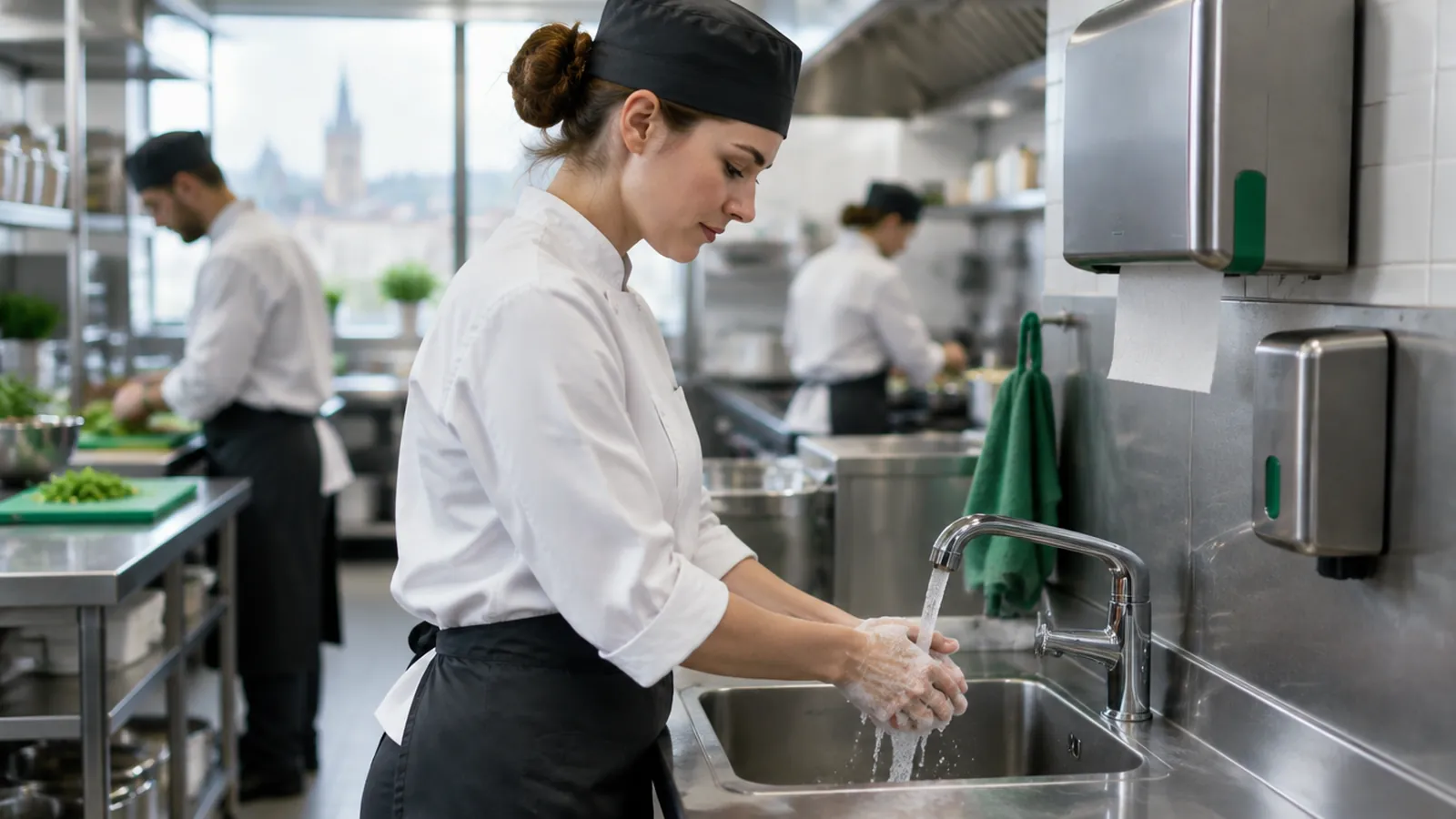
Running hot and cold water, soap, paper towels. Not the cloth from the worktop. Not your trouser leg. The NVWA is specific about that on working clean and safely (in Dutch). A sink that also rinses the lettuce is not a handwash.
Wet, soap, every side of the fingers and under the nails, rinse, dry with paper. You turn the tap off with that same paper, not with the clean hand. Twenty seconds feels long in a rush. The rush is not an excuse the inspector takes home.
Gloves do not replace the tap
Gloves keep your hands out of the food. They do not wash those hands. Put them on over dirty hands and the dirt sits on the inside. Touch the bin, the door handle or your phone afterwards and it sits on the outside too. The salad gets both.
- Wash your hands before you put the glove on, and after you take it off.
- Change between raw and ready-to-eat. One pair for the whole shift is not a pair.
- Take them off for the phone, the bin or the till. Then wash again.
- A torn glove goes. No tape, no ‘a little longer’.
Mustard on the glove is the same hazard as mustard on the board: an allergen that travels along. A dry cloth over it does not remove it. That is in Celery counts. Strawberry does not..
Rings, watches, chains
Food stays under a ring. Under a watch too. The hygiene code is short about that: jewellery off hands and wrists. A wedding ring counts. ‘I never take it off’ is not a control point.
Long chains and earrings do not belong over the soup. Nail polish and fake nails come loose or hold dirt. In the teams we speak to the classic is the watch that stays on ‘just for the time’. The time is on the clock on the wall.
Hair and clean workwear
Hair in the food is not seasoning. Long hair tied back, or a net. A beard that hangs in the sauce is the same. The hygiene code asks that hair cannot touch the food.
Workwear is clean when you start, and it belongs in the kitchen. Not the jumper from the bus, not the jacket you took the bin out in. If it gets dirty, you change it. In a sports canteen the classic is the volunteer who pulls pints, scoops fries and empties the bin in the same hoodie.
A cut gets a blue plaster
An open wound does not belong over the food. First a waterproof, coloured plaster — usually blue in the kitchen, so you find it if it comes off — and a glove over that. A skin-coloured plaster disappears in the salad.
An infected wound, pus, or an inflamed nail: no contact with unpackaged food. Report it, cover it, or stay home. That is not optional.
Stay home, or say so
Diarrhoea, vomiting, fever, or an infected wound: you do not work with food. The hygiene code and the NVWA put that in general terms. Anyone with an illness that can travel through food does not belong in the kitchen. No ‘I already feel better’ after one trip to the toilet.
After diarrhoea or vomiting, 48 hours without symptoms is the usual line in the Hygiene Code for Hospitality. Not a legal sentence you have to recite from memory. It is the agreement the inspector expects when they ask why someone was still ill yesterday and is plating up tonight.
Tell someone. An employer cannot send you home from a shift they do not know about. In the test, working on with diarrhoea is the wrong answer, even when the team is short.
What the employer arranges
The team can only wash if there is a sink. Not the sink that rinses the lettuce. A handwash point with running hot and cold water, soap and paper. In a truck: a tank that lasts the service. An empty dispenser by the door is what the inspector sees in The inspector is at the door.
On top of that, a sick-reporting rule everyone knows. Not ‘just text if you really can’t’. Instruction belongs there too: when to wash, why the ring comes off, what you do with a cut. A cleaning plan gets the bacteria off the worktop. Personal hygiene gets them off the hand that touches that worktop.
Temperatures, the other side of the same shift, are in 11 degrees at the door is not a delivery. A paper certificate does not wash any hands. It does help if the team recognises the moments before someone with a clipboard is standing in the kitchen. The HACCP course practises the same points: hands, receiving, temperature, cross-contamination, allergens. No classroom evening. A link, a test, and a PDF in your name. What that paper is worth is in the HACCP certificate.
Frequently asked questions
Do gloves replace washing your hands?
- No. Wash before you put them on and after you take them off. Change between raw and ready-to-eat. A glove over dirty hands traps the dirt; it does not remove it.
When do you have to wash your hands in the kitchen?
- Before you start, after the toilet, after raw meat, fish or eggs, after the bin, after the phone, after smoking or a break, and between raw and ready-to-eat. Even when they look clean.
Can you work with diarrhoea or vomiting?
- No. Diarrhoea, vomiting, fever or an infected wound do not belong near unpackaged food. In the Hygiene Code for Hospitality, 48 hours without symptoms after diarrhoea or vomiting is the usual line. Tell your employer.