Kitchen
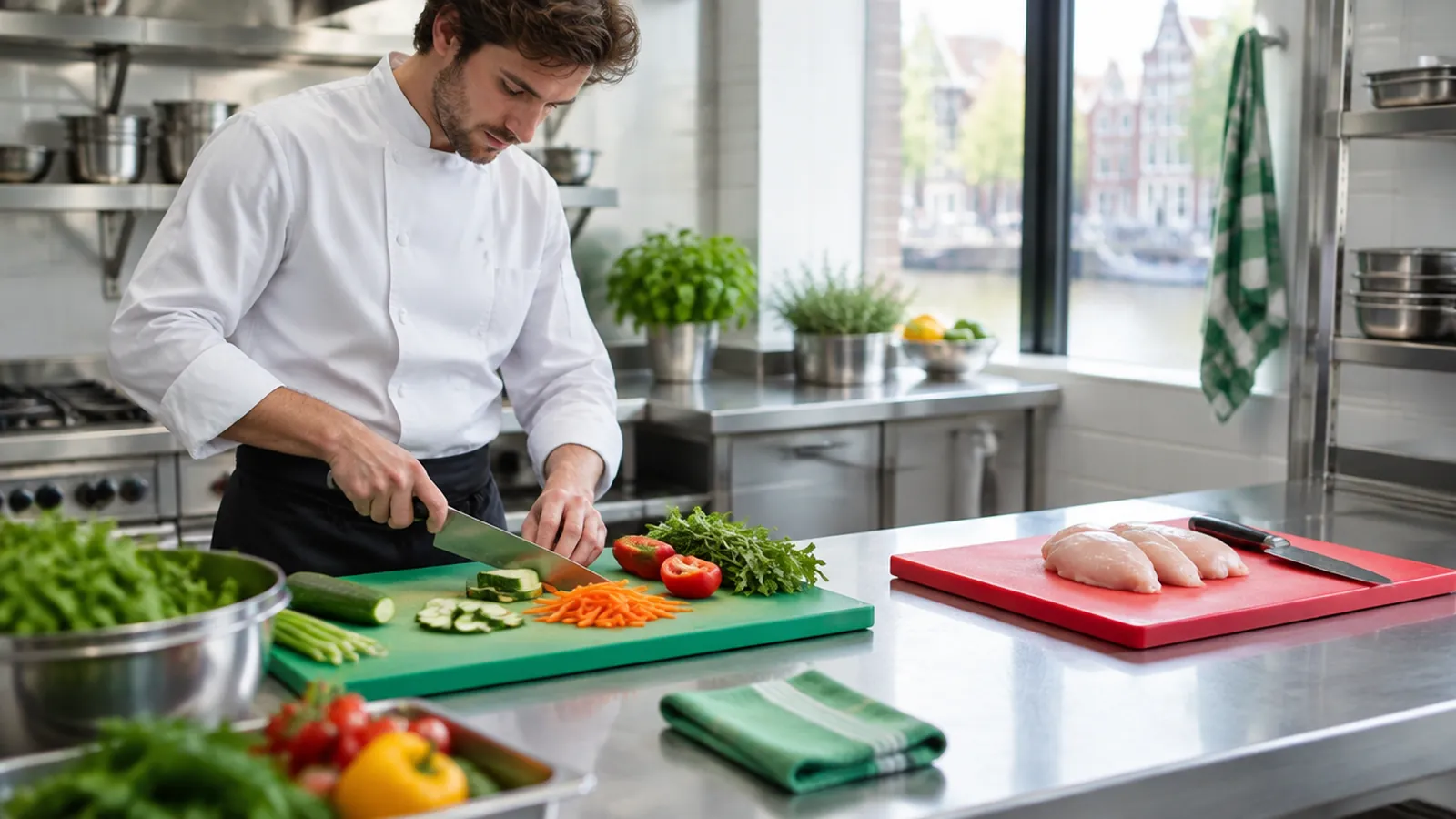
The red board is not for the salad
Kitchen5 min read
In the rush someone cuts the chicken, flips the board, and puts the lettuce on it. In the sports canteen it happens with one knife for the fried-egg sandwich and the bowl of cucumber. In the food truck there is sometimes only one board on board. That is not speed. That is cross-contamination.
It applies in a restaurant with three services, behind a club counter, and behind the hatch of a truck. The menu differs. The hazard does not: whatever travels from one product or surface to another.
Three ways it goes wrong
Cross-contamination is transferring a hazard from one product or surface to another. Via hands, chopping boards, knives, cloths, or juices that drip downwards. In the test the example is raw chicken and then lettuce. The lettuce does not go into a pan afterwards.
- Bacterial. Raw meat or poultry can carry bacteria. If that lands on something that will not be heated again, the hazard stays.
- Allergen. Mustard, nuts or celery on a board, in a pan or in shared fryer oil. Cooking does not remove it.
- Physical. A shard of glass, a hair, a plaster that travels along. Not spoilage, but something that does not belong in the food.
Raw and ready-to-eat stay apart
Ready-to-eat is anything that can go straight onto the plate: lettuce, bread, cheese, a sliced tomato, a sauce that will not be heated again. Raw meat, raw fish and raw chicken do not sit next to that, and not on the same board.
After raw chicken: a different board, a different knife, wash your hands. Flipping the board or rinsing it quickly with cold water is the wrong answer in the test. Clean it thoroughly, or take a clean board. The same goes after mustard, for a different reason. That is in Celery counts. Strawberry does not..
Colour on the board, colour on the knife
Many kitchens put a colour on that. Red for raw meat, yellow for poultry, green for vegetables, blue for fish. The law does not prescribe those colours. What it does ask: no bacteria or allergens from one product onto another.
| Colour | Commonly used for |
|---|---|
| Red | Raw meat |
| Yellow | Poultry |
| Green | Fruit and vegetables |
| Blue | Fish |
A set that stays in the drawer, and one green board that sees everything, is not a system. Neither is the same knife for the chicken and the salad. In a canteen or truck with fewer boards: wash thoroughly in between, or use disposable. Less equipment is not a free pass.
Wash your hands, change your gloves
Hands are the shortest route between raw and ready-to-eat. Wash them at the moments that matter: after raw food, after waste, after the toilet, and before you touch anything that goes straight onto the plate. Soap, running water, paper. Gel helps. It does not replace washing.
Gloves get just as dirty as hands. Wash your hands before you put them on. Change them after raw food, waste or a change of task, as often as you would otherwise wash your hands. The same pair for the whole shift is one dirty glove. Gloves do not mean you wash your hands less.
The cloth that goes everywhere
A damp cloth is a breeding ground, even when it looks clean. The toilet cloth does not go on the worktop. Neither does the floor cloth. In a sports canteen the classic is the cloth that wipes the toastie grill and then the worktop. That is one cloth, two hazards.
Replace dishcloths at least every day, and straight away when they are dirty. Or use disposable ones. More on that rhythm is in A damp cloth is not a cleaning plan.
At the bottom of the fridge, not above
Store raw meat, poultry and fish covered at the bottom. Cooked food and lettuce sit above that. Then juices cannot drip down onto something that goes straight onto the plate. Next to the vegetables, on the same shelf, is the wrong answer in the test.
| What | Where |
|---|---|
| Cooked food, lettuce, cheese | Above, covered |
| Raw meat, poultry, fish | At the bottom, covered |
| Open tubs | With a date you can read |
The fridge itself has to be cold enough. Most chilled goods at 7°C or lower, or colder if the label asks for it. Those numbers are in 11 degrees at the door is not a delivery.
An allergen is cross-contamination too
A guest mentions nuts. Picking the nuts off afterwards does not help: traces stay. Clean hands, a clean surface, separate tools, and keep the dish apart until it leaves the pass. Shared fryer oil can carry traces of fish or breadcrumbs. You tell the guest that, or you use a separate fryer.
The fourteen, including celery and mustard, are in Celery counts. Strawberry does not..
What the hygiene code makes of this
Anyone who prepares, processes or sells food must work with a HACCP food safety plan. Most hospitality businesses follow the Hygiene Code for Hospitality from Koninklijke Horeca Nederland. The NVWA has approved that code. Cross-contamination is not a separate diploma in it. It is a hazard you name and keep apart: raw and ready-to-eat, board and knife, hands in between.
The inspector does not ask whether you can recite the colours. They ask whether tonight’s lettuce sat on the chicken board, and whether someone can explain that. That belongs to the same round as temperature and cleaning. More on that in The inspector is at the door. Now what?.
The HACCP course practises the same points: hands, receiving, temperature, cross-contamination, allergens. No classroom evening. A link, a test, and a PDF in your name.